Double Elimination Bracket
Updated
Lose twice and you're out. A first loss drops a team from the winners bracket to the losers bracket; a second loss ends its run.
Winners bracket
Every team starts here. Keep winning and you stay unbeaten.
Losers bracket
One loss sends you here to play on. A second loss and you're out.
Grand final
The two bracket winners meet. If the losers-bracket team wins, both have one loss, so an if-necessary game decides the title.
How many games in double elimination?
Every team except the champion loses twice, so n teams need 2n − 2 games, and 2n − 1 when the grand final goes to a second game.
| Teams | Games | Winners + losers rounds | Byes | Hours on 2 fields |
|---|---|---|---|---|
| 4 | 6 or 7 | 2 + 2 | 0 | 4 to 5 |
| 6 | 10 or 11 | 3 + 3 | 2 | 7 to 8 |
| 8 | 14 or 15 | 3 + 4 | 0 | 9 to 10 |
| 10 | 18 or 19 | 4 + 5 | 6 | 11 to 12 |
| 12 | 22 or 23 | 4 + 5 | 4 | 13 to 14 |
| 16 | 30 or 31 | 4 + 6 | 0 | 17 to 18 |
| 24 | 46 or 47 | 5 + 7 | 8 | 25 to 26 |
| 32 | 62 or 63 | 5 + 8 | 0 | 33 to 34 |
| 64 | 126 or 127 | 6 + 10 | 0 | 65 to 66 |
Hours: one-hour games on two fields, each game starting as soon as a field is free and both teams are known, the way the bracket maker schedules them. The higher figure includes the if-necessary game.
How the losers bracket works
A team's first loss drops it into the losers bracket, where one more loss ends its day. The losers bracket takes turns between two kinds of rounds: in one, the teams already there play each other; in the next, the survivors meet the teams that just lost in the winners bracket. That is why it has two rounds fewer than twice the winners bracket: 6 losers rounds against 4 winners rounds with 16 teams.
With 6 or more teams, teams that lose in winners round 2 drop in reverse order, so their first losers-bracket game is never a round 1 rematch. With 4 or 5 teams it can be.
The if-necessary game
The grand final puts the unbeaten winners-bracket champion against the losers-bracket champion, who already has one loss. If the winners-bracket team wins, the tournament is over. If the losers-bracket team wins, both teams have one loss, so they play again and that game decides the title. This is sometimes called true double elimination. Some events skip it to save time, so the unbeaten team can go out after one loss.
Source: 2025 NCAA Men's College World Series bracket (PDF), where each 4-team double elimination bracket ends with an if-necessary game, played only when the team from the losers side wins the first meeting, checked October 19, 2026.
Worked example: 6 teams
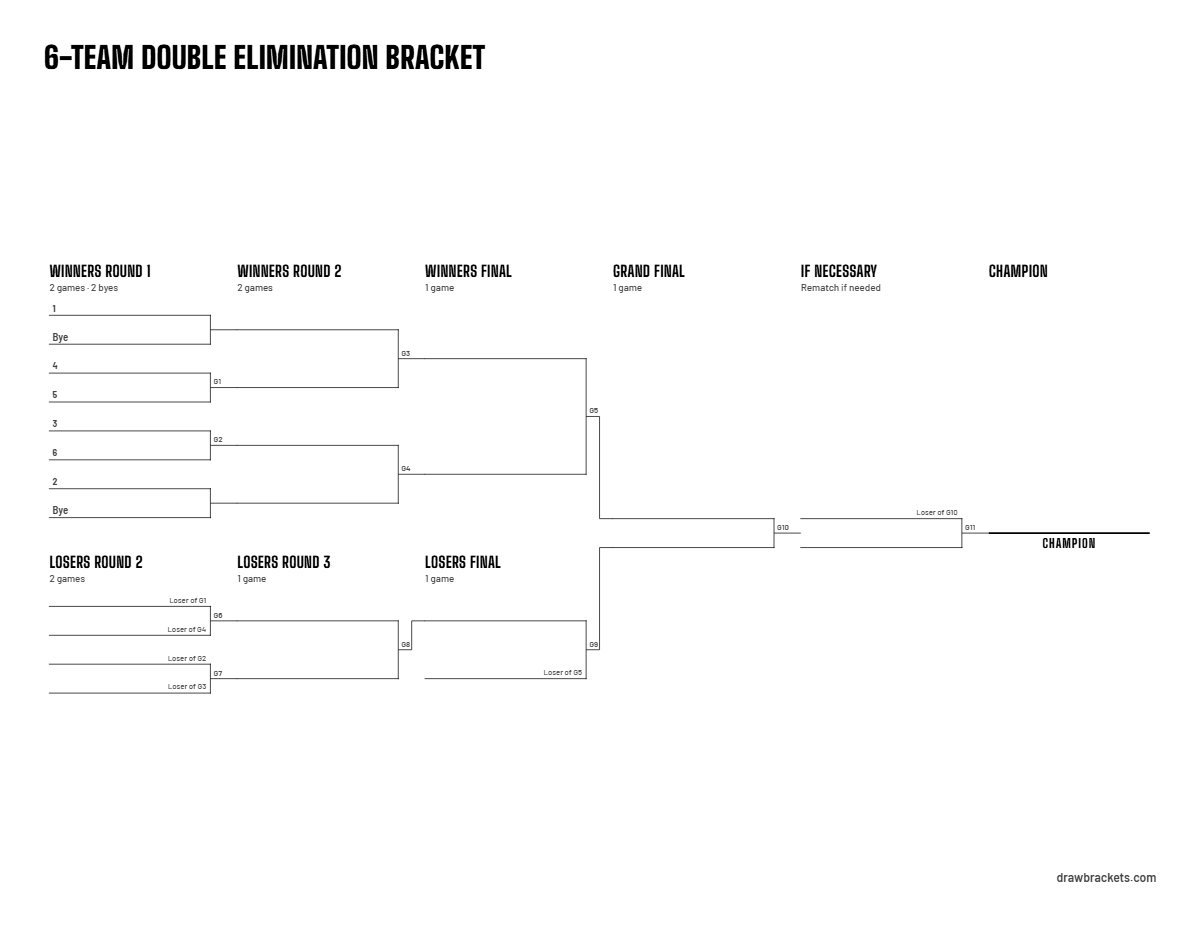
6 teams need 10 games, or 11 with the if-necessary final. The bracket is drawn for 8, so seeds 1 and 2 get byes, and losers round 1 has no games: the first teams to drop wait a round. The game numbers match the diagram above:
- Winners round 1: G1, seed 4 vs seed 5; G2, seed 3 vs seed 6.
- Winners round 2: G3, seed 1 vs the winner of G1; G4, the winner of G2 vs seed 2.
- Winners final: G5, the winner of G3 vs the winner of G4.
- Losers round 2: G6, the loser of G1 vs the loser of G4; G7, the loser of G2 vs the loser of G3.
- Losers round 3: G8, the winner of G6 vs the winner of G7.
- Losers final: G9, the winner of G8 vs the loser of G5.
- Grand final: G10, the winner of G5 vs the winner of G9.
- If-necessary game: G11, a rematch of G10, played only if the losers-bracket team wins it.
The losers bracket games are crossed, so neither of the first two can be a rematch. Every team plays at least 2 games and at most 7. On two fields with one-hour games it takes 7 hours, or 8 hours if G11 is played.
Double or single elimination?
Double elimination about doubles the games: 8 teams play 14 or 15 instead of 7, around 9 hours on two fields instead of 4 hours. In return every team plays at least twice, or three times with a 3-game guarantee. When time is short, a single elimination bracket is faster.
Double elimination bracket questions
Does the losers-bracket team have to win the final twice?
Yes. It arrives with one loss and the winners-bracket team has none, so it has to win the grand final (G10 with 6 teams) and then the if-necessary game (G11).
How are byes placed in double elimination?
As in single elimination: the gap to the next power of two goes to the top seeds, and the empty spots carry over into losers round 1.
Printable double elimination brackets, PDF & Excel
- 3teams4–5 games
- 4teams6–7 games
- 5teams8–9 games
- 6teams10–11 games
- 7teams12–13 games
- 8teams14–15 games
- 9teams16–17 games
- 10teams18–19 games
- 11teams20–21 games
- 12teams22–23 games
- 13teams24–25 games
- 14teams26–27 games
- 15teams28–29 games
- 16teams30–31 games
- 20teams38–39 games
- 24teams46–47 games
- 32teams62–63 games
- 64teams126–127 games