Progressive Euchre Score Sheets
Free score cards for a progressive euchre night, where you change partners every round and keep your own score, plus a rotation chart that gives every player a new partner each round.
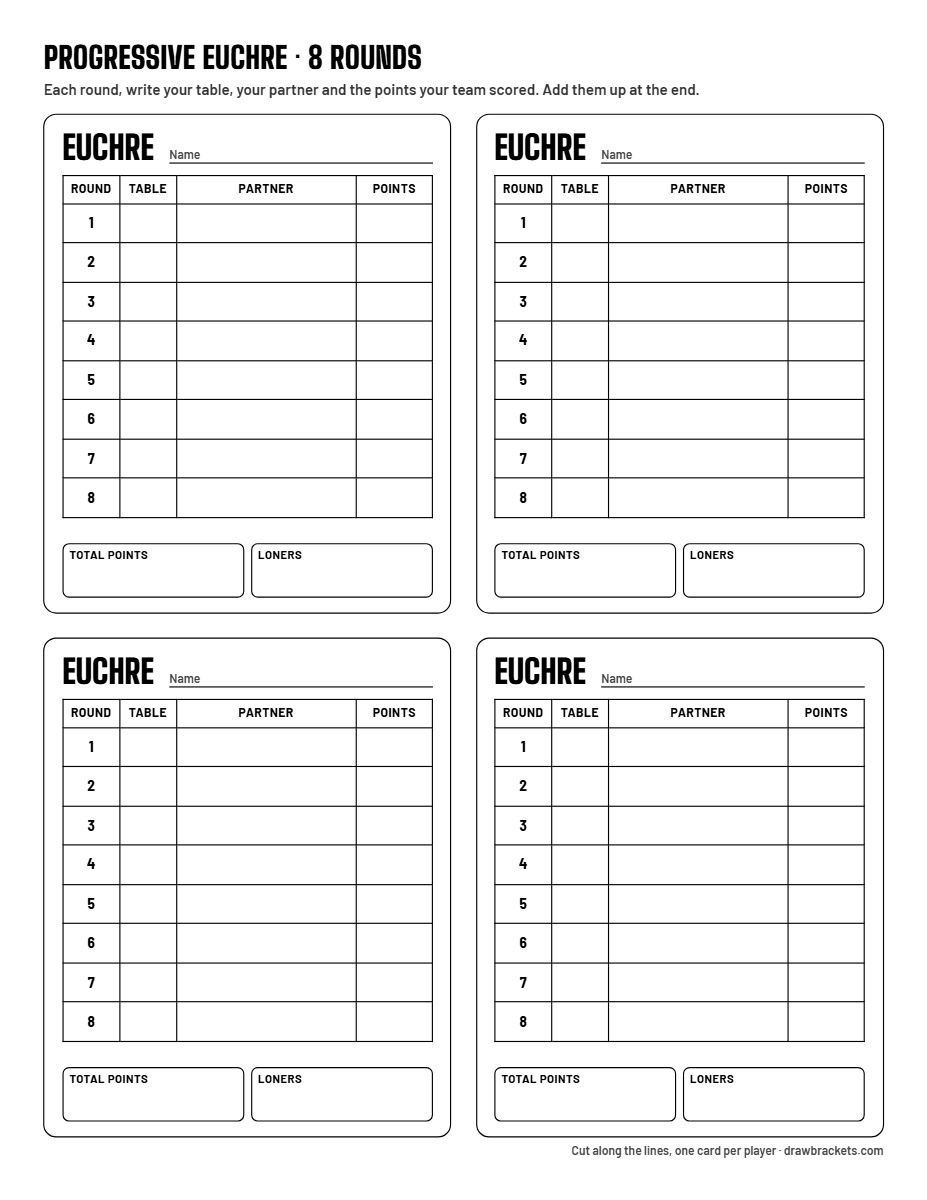
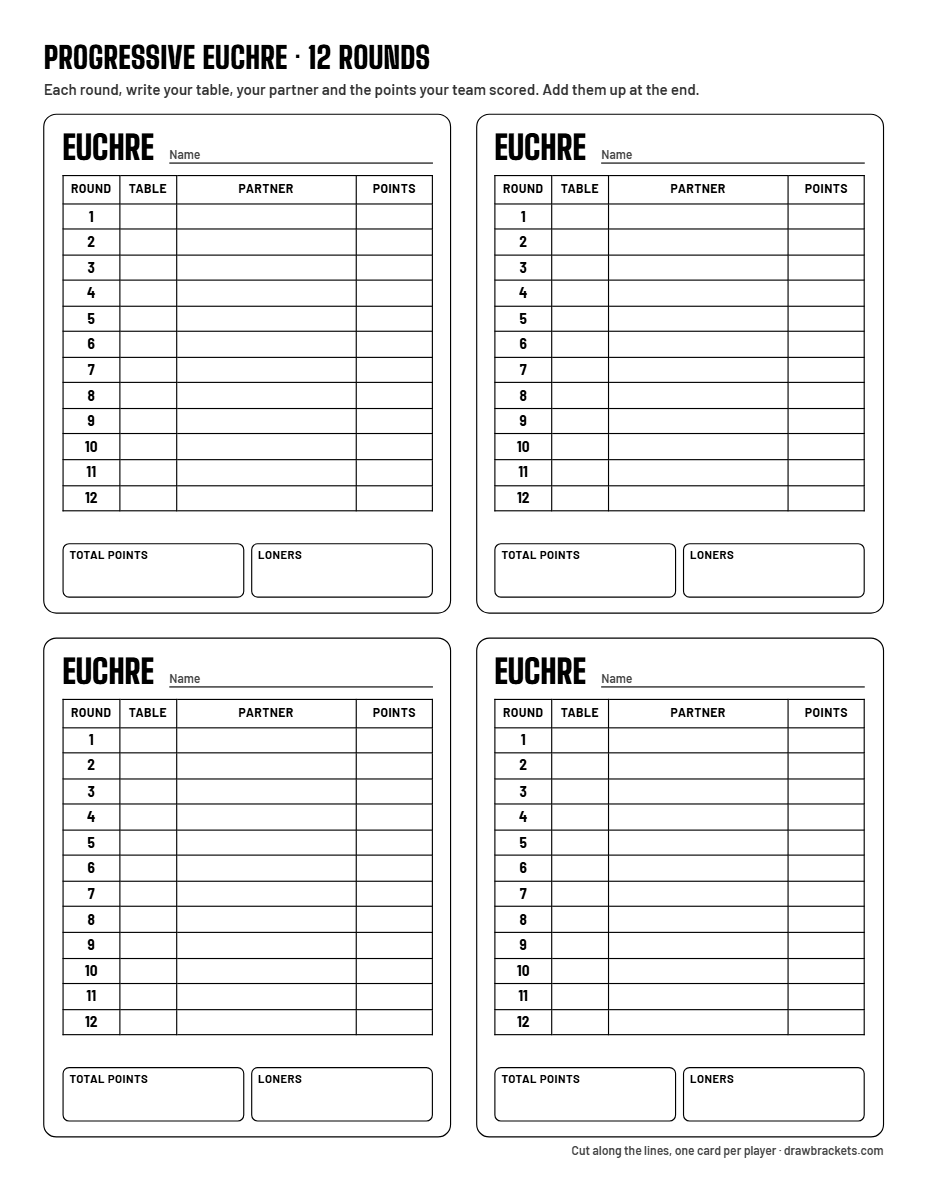
Partner rotation chart
How many players?
8 players · 2 tables · 7 rounds
Chart PDF53 KB| Round | Table 1 | Table 2 |
|---|---|---|
| 1 | 1 & 2 vs 3 & 4 | 5 & 6 vs 7 & 8 |
| 2 | 1 & 3 vs 5 & 7 | 2 & 4 vs 6 & 8 |
| 3 | 1 & 5 vs 4 & 8 | 2 & 6 vs 3 & 7 |
| 4 | 1 & 4 vs 6 & 7 | 2 & 3 vs 5 & 8 |
| 5 | 1 & 7 vs 2 & 8 | 3 & 5 vs 4 & 6 |
| 6 | 1 & 8 vs 3 & 6 | 2 & 7 vs 4 & 5 |
| 7 | 1 & 6 vs 2 & 5 | 3 & 8 vs 4 & 7 |
Every player has 7 different partners, and nobody meets the same opponent more than twice.
12 players · 3 tables · 8 rounds
Chart PDF61 KB| Round | Table 1 | Table 2 | Table 3 |
|---|---|---|---|
| 1 | 1 & 2 vs 3 & 4 | 5 & 6 vs 7 & 8 | 9 & 10 vs 11 & 12 |
| 2 | 1 & 3 vs 5 & 7 | 2 & 8 vs 6 & 12 | 4 & 9 vs 10 & 11 |
| 3 | 1 & 5 vs 4 & 11 | 2 & 7 vs 8 & 10 | 3 & 12 vs 6 & 9 |
| 4 | 1 & 4 vs 6 & 8 | 2 & 3 vs 9 & 11 | 5 & 10 vs 7 & 12 |
| 5 | 1 & 11 vs 7 & 10 | 2 & 12 vs 4 & 6 | 3 & 9 vs 5 & 8 |
| 6 | 1 & 8 vs 2 & 11 | 3 & 7 vs 4 & 12 | 5 & 9 vs 6 & 10 |
| 7 | 1 & 7 vs 9 & 12 | 2 & 6 vs 5 & 11 | 3 & 8 vs 4 & 10 |
| 8 | 1 & 6 vs 3 & 10 | 2 & 4 vs 7 & 9 | 5 & 12 vs 8 & 11 |
Every player has 8 different partners, and nobody meets the same opponent more than twice.
16 players · 4 tables · 8 rounds
Chart PDF66 KB| Round | Table 1 | Table 2 | Table 3 | Table 4 |
|---|---|---|---|---|
| 1 | 1 & 2 vs 3 & 4 | 5 & 6 vs 7 & 8 | 9 & 10 vs 11 & 12 | 13 & 14 vs 15 & 16 |
| 2 | 1 & 7 vs 11 & 16 | 2 & 5 vs 10 & 13 | 3 & 12 vs 14 & 15 | 4 & 9 vs 6 & 8 |
| 3 | 1 & 3 vs 5 & 7 | 2 & 8 vs 10 & 14 | 4 & 12 vs 11 & 15 | 6 & 9 vs 13 & 16 |
| 4 | 1 & 5 vs 6 & 12 | 2 & 11 vs 14 & 16 | 3 & 7 vs 8 & 9 | 4 & 10 vs 13 & 15 |
| 5 | 1 & 13 vs 9 & 14 | 2 & 12 vs 6 & 7 | 3 & 10 vs 4 & 16 | 5 & 15 vs 8 & 11 |
| 6 | 1 & 11 vs 2 & 13 | 3 & 16 vs 8 & 12 | 4 & 6 vs 5 & 14 | 7 & 9 vs 10 & 15 |
| 7 | 1 & 16 vs 8 & 15 | 2 & 14 vs 5 & 9 | 3 & 6 vs 10 & 11 | 4 & 13 vs 7 & 12 |
| 8 | 1 & 14 vs 7 & 10 | 2 & 6 vs 12 & 15 | 3 & 8 vs 11 & 13 | 4 & 5 vs 9 & 16 |
Every player has 8 different partners, and nobody meets the same opponent more than twice.
20 players · 5 tables · 8 rounds
Chart PDF73 KB| Round | Table 1 | Table 2 | Table 3 | Table 4 | Table 5 |
|---|---|---|---|---|---|
| 1 | 1 & 2 vs 3 & 4 | 5 & 6 vs 7 & 8 | 9 & 10 vs 11 & 12 | 13 & 14 vs 15 & 16 | 17 & 18 vs 19 & 20 |
| 2 | 1 & 20 vs 7 & 10 | 2 & 15 vs 9 & 16 | 3 & 8 vs 4 & 18 | 5 & 13 vs 6 & 17 | 11 & 19 vs 12 & 14 |
| 3 | 1 & 16 vs 8 & 17 | 2 & 11 vs 13 & 19 | 3 & 14 vs 5 & 12 | 4 & 6 vs 15 & 20 | 7 & 9 vs 10 & 18 |
| 4 | 1 & 11 vs 5 & 15 | 2 & 7 vs 8 & 12 | 3 & 17 vs 10 & 14 | 4 & 19 vs 6 & 9 | 13 & 16 vs 18 & 20 |
| 5 | 1 & 3 vs 9 & 19 | 2 & 17 vs 6 & 7 | 4 & 11 vs 16 & 18 | 5 & 14 vs 10 & 13 | 8 & 15 vs 12 & 20 |
| 6 | 1 & 4 vs 12 & 13 | 2 & 18 vs 10 & 15 | 3 & 11 vs 7 & 17 | 5 & 19 vs 16 & 20 | 6 & 8 vs 9 & 14 |
| 7 | 1 & 6 vs 11 & 16 | 2 & 12 vs 5 & 18 | 3 & 9 vs 13 & 20 | 4 & 7 vs 14 & 17 | 8 & 10 vs 15 & 19 |
| 8 | 1 & 14 vs 2 & 20 | 3 & 12 vs 6 & 16 | 4 & 8 vs 10 & 11 | 5 & 17 vs 9 & 18 | 7 & 19 vs 13 & 15 |
Every player has 8 different partners, and nobody meets the same opponent more than twice.
24 players · 6 tables · 8 rounds
Chart PDF77 KB| Round | Table 1 | Table 2 | Table 3 | Table 4 | Table 5 | Table 6 |
|---|---|---|---|---|---|---|
| 1 | 1 & 2 vs 3 & 4 | 5 & 6 vs 7 & 8 | 9 & 10 vs 11 & 12 | 13 & 14 vs 15 & 16 | 17 & 18 vs 19 & 20 | 21 & 22 vs 23 & 24 |
| 2 | 1 & 12 vs 11 & 22 | 2 & 23 vs 8 & 9 | 3 & 17 vs 4 & 16 | 5 & 13 vs 6 & 14 | 7 & 19 vs 10 & 15 | 18 & 20 vs 21 & 24 |
| 3 | 1 & 18 vs 5 & 8 | 2 & 10 vs 20 & 23 | 3 & 7 vs 11 & 13 | 4 & 15 vs 6 & 12 | 9 & 24 vs 16 & 17 | 14 & 22 vs 19 & 21 |
| 4 | 1 & 9 vs 19 & 24 | 2 & 14 vs 12 & 18 | 3 & 15 vs 5 & 20 | 4 & 7 vs 16 & 23 | 6 & 8 vs 11 & 21 | 10 & 13 vs 17 & 22 |
| 5 | 1 & 22 vs 6 & 7 | 2 & 18 vs 13 & 15 | 3 & 16 vs 19 & 23 | 4 & 24 vs 8 & 10 | 5 & 12 vs 17 & 20 | 9 & 11 vs 14 & 21 |
| 6 | 1 & 4 vs 15 & 21 | 2 & 8 vs 14 & 17 | 3 & 9 vs 6 & 22 | 5 & 7 vs 12 & 24 | 10 & 20 vs 13 & 16 | 11 & 23 vs 18 & 19 |
| 7 | 1 & 23 vs 13 & 17 | 2 & 6 vs 10 & 16 | 3 & 18 vs 7 & 9 | 4 & 22 vs 5 & 11 | 8 & 21 vs 12 & 15 | 14 & 19 vs 20 & 24 |
| 8 | 1 & 5 vs 2 & 16 | 3 & 22 vs 8 & 15 | 4 & 10 vs 9 & 18 | 6 & 11 vs 17 & 24 | 7 & 23 vs 14 & 20 | 12 & 21 vs 13 & 19 |
Every player has 8 different partners, and nobody meets the same opponent twice.
The chart plans 7 rounds for 8 players, who run out of new partners after that, and 8 for 12 or more. Playing longer? Take the 12-round card and move the winners up a table, the classic way described below.
How the night runs
- Give everyone a number, 1 to the number of players, and a score card.
- Each round, find your number in the chart: that is your table, and the number paired with yours is your partner.
- Play the agreed number of hands, then write your table, partner and team points on your card.
- After the last round, add up your card. The highest total wins.
In the classic version the winners move up a table toward the head table and split up, so partners change without a chart; Foster's Complete Hoyle describes it with numbered tables and a bell at the head table. Use the chart when you want every partner to be new.
Points per hand
| The side that called trump takes 3 or 4 tricks | 1 point |
| It takes all 5 tricks, a march | 2 points |
| A player going alone takes 3 or 4 tricks | 1 point |
| A player going alone takes all 5 | 4 points |
| The side that called trump takes fewer than 3, euchred | 2 points to the other side |
Write your team's points on your own card after each round. The Loners box is for groups that give a prize for the most lone hands.
Sources: Bicycle, How to play Euchre; R. F. Foster, Foster's Complete Hoyle (Project Gutenberg). Checked September 29, 2026.
Progressive euchre questions
How many hands is a round?
Agree on it before you start, the same for every table. Eight hands lets each of the four players at a table deal twice.
What if the players are not a multiple of 4?
The charts are for full tables of four: 8, 12, 16, 20 or 24 players. With one to three players over, some take turns sitting out a round; the chart does not plan that for you.
Who wins progressive euchre?
The player with the most points after the last round. Partners change every round, so everyone adds up their own card and each total is personal.